 Österreich
 EU
EU
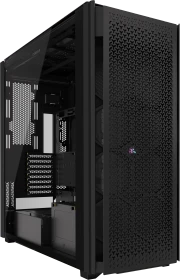
Black, Glasfenster
CC-9011273-WW
ab
€ 469,90



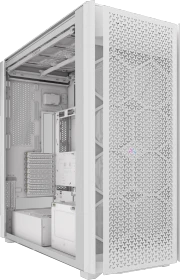
Corsair's 9000D Airflow super-tower improves the previous 1000D design, making it more appealing to water coolers and system builders.

Das 9000D RGB Airflow ist das neue Airflow-Flaggschiff von Corsair. Das riesige Gehäuse wartet mit beeindruckenden Nutzungsmöglichkeiten auf: Es nimmt vier 480-mm-Radiatoren, bis zu 18 120-mm-Lüfter und sogar zwei voneinander unabhängige PC-Systeme auf.

The Corsair 9000D RGB Airflow is clearly the brands biggest case. With its massive width, height and depth, you may be surprised to hear that it "only" costs $500 retail. That actually feels cheap in the super tower category, as that is a pretty small category and other offerings cost as much as twice that. Even if it feels relatively low, the price tag of the Corsair 9000D RGB Airflow is still clearly in the space of "money is no object," with the chassis catering to a target audience that will then end up spending upwards of 10s of thousands on hardware, custom liquid cooling and RGB fans. And to that audience the case caters extremely well. The radiator setups that you can throw into this case are—for a lack of a better word—insane. That can also be attributed to Corsairs' InfiniRail system, which provides a level of flexibility that the original super tower, the 1000D, could not. It will be interesting to see if Corsair plans to bring this to smaller, more mainstream enclosures in the future. Considering they gave it a marketing name, it seems the odds are pretty good. While one would be totally fine with a chassis of this size allowing for crazy custom loops on its own, being able to install a secondary ITX system is a welcome capability. While there are a few cases out there which already provide dual-system support, the Corsair 9000D RGB Airflow manages to do so without any real compromises, except for when using two large air cooled GPUs, doing so creates a little bit of a hot zone. But this feels like underutilizing the chassis anyway, because it has enough room and capabilities to have both systems independently custom liquid cooled anyway. There are a few issues around assembly or more specifically disassembly, with the ITX system sitting on top of the PSU shroud, which you will need to remove to gain access to the ATX power supply of the primary system. Besides that, the secondary SFX PSU not having access to fresh exterior air feels like an oversight from Corsair. And while it is great to have a genuine USB-C hub built into the case, resulting in one cable to connect to your motherboard, it also means that you can no longer split the ports between both systems, unlike with the 1000D. Overall, the Corsair 9000D RGB Airflow does feel like an evolution of the 1000D, with its tooling tweaks, addition of features and unique elements. There are still some areas of improvement and potential, but the reality is if you are planning on building a massive, custom liquid cooled system—which you don't plan to move around much—the Corsair 9000D RGB Airflow pretty much tops everything else out there. If you consider the fact that it can also do dual-system builds, the list of alternatives all but disappears. Being so unique, the case manages to deliver all the fixings and more you would look for in a super tower case.

Alle Angaben ohne Gewähr. Die gelisteten Angebote sind keine verbindlichen Werbeaussagen der Anbieter.
* Preise in Euro inkl. MwSt. zzgl. Versandkosten. Bei der Auswahl von "inkl. Versand" beinhaltet der dargestellte Preis die Kosten für den Versand. Die nicht angeführten Kosten in andere Länder entnimm bitte der Website des Händlers. Bei Sortierung nach einer anderen als der Landeswährung des Händlers basiert die Währungsumrechnung auf einem von uns ermittelten Tageskurs, der womöglich nicht mit dem im Shop angegebenen Preis exakt übereinstimmt. Bitte bedenke außerdem, dass die angeführten Preise periodisch erzeugte Momentaufnahmen darstellen und technisch bedingt teilweise veraltet sein können. Insbesondere sind Preiserhöhungen zwischen dem Zeitpunkt der Preisübernahme durch uns und dem späteren Besuch dieser Website möglich. Händler haben keine Möglichkeit die Darstellung der Preise direkt zu beeinflussen und sofortige Änderungen auf unserer Seite zu veranlassen. Der maßgebliche Preis für den Verkauf durch den Händler ist der tatsächliche Preis des Produkts, der zum Zeitpunkt des Kaufs auf der Website des Händlers steht.